DevSecOps: Enabling Scalable Enterprise AI Adoption
DevSecOps: Enabling Scalable Enterprise AI Adoption
DevSecOps: Enabling Scalable Enterprise AI Adoption
Introduction
Introduction
Introduction
Many enterprises want to embrace AI, but few are prepared for what it really takes. A recent project delivered by Cygnus Consulting illustrates how a secure, scalable, and automation-driven DevSecOps approach can unlock AI at scale across the enterprise.
Many enterprises want to embrace AI, but few are prepared for what it really takes. A recent project delivered by Cygnus Consulting illustrates how a secure, scalable, and automation-driven DevSecOps approach can unlock AI at scale across the enterprise.
Many enterprises want to embrace AI, but few are prepared for what it really takes. A recent project delivered by Cygnus Consulting illustrates how a secure, scalable, and automation-driven DevSecOps approach can unlock AI at scale across the enterprise.
Quick Summary
Quick Summary
Quick Summary
Legacy Systems: Traditional IT systems were fragmented and couldn't support AI workloads.
DevSecOps Framework: Cygnus implemented a cloud-native platform on Azure, integrating AI with secure, scalable infrastructure.
Key Benefits: Faster innovation, improved compliance, and reduced complexity in AI deployment.
Impact: The AI-ready platform paves the way for advanced use cases like predictive insights and intelligent automation
Legacy Systems: Traditional IT systems were fragmented and couldn't support AI workloads.
DevSecOps Framework: Cygnus implemented a cloud-native platform on Azure, integrating AI with secure, scalable infrastructure.
Key Benefits: Faster innovation, improved compliance, and reduced complexity in AI deployment.
Impact: The AI-ready platform paves the way for advanced use cases like predictive insights and intelligent automation
Legacy Systems: Traditional IT systems were fragmented and couldn't support AI workloads.
DevSecOps Framework: Cygnus implemented a cloud-native platform on Azure, integrating AI with secure, scalable infrastructure.
Key Benefits: Faster innovation, improved compliance, and reduced complexity in AI deployment.
Impact: The AI-ready platform paves the way for advanced use cases like predictive insights and intelligent automation
The Problem: Legacy Integration Held Back AI Potential
A large enterprise was gearing up for a major digital transformation. But its existing integration landscape was fragmented, manually operated, and lacked the core capabilities needed to support AI workloads. These systems could not deliver the scalability, security, or automation required for real-time insights, intelligent automation, or generative assistants.
The organization needed more than just AI tools. It needed a secure, centralized integration platform that could serve as the backbone of an AI-powered future.
The Approach: AI-Ready Integration Built with DevSecOps
Cygnus Consulting designed and implemented a cloud-native integration platform using Microsoft Azure. This platform was built to connect traditional systems with next-generation AI models through a modern DevSecOps framework.
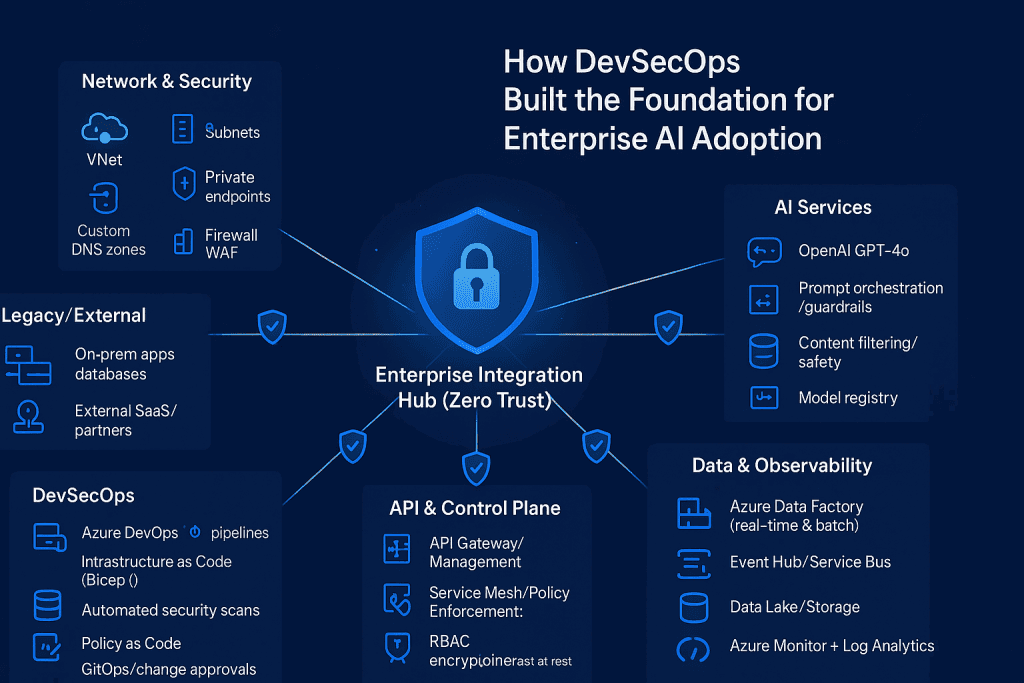
The architecture used a hub-and-spoke model to centralize control and promote reuse across business units. At its core, it acted as a digital nervous system, enabling secure data flow, API orchestration, and seamless integration with AI services.
Key Elements of the Solution:
Secure Infrastructure: Dedicated virtual networks and subnets with private endpoints and custom DNS zones to prevent public exposure
Automation by Design: Infrastructure-as-Code using Bicep, along with fully automated CI/CD pipelines in Azure DevOps
Built-in AI Support: Integration with OpenAI GPT-4o to enable features like chat, summarization, and voice-to-text
Centralized Secrets Management: Azure Key Vault to manage API keys and credentials securely
End-to-End Monitoring: Azure Monitor and Log Analytics to provide full visibility into performance, health, and usage.
DevSecOps Principles Driving AI Readiness:
API-First Design: Ensures modular, secure connections between AI services, data platforms, and business systems
Zero Trust Security: All traffic to AI endpoints is routed through controlled gateways with strict RBAC and encryption
Automated Deployment: Every integration and AI service is deployed through pipelines to eliminate human error and reduce cycle time
Real-Time Data Pipelines: Azure Data Factory pipelines move both structured and unstructured data into AI processing flows
Use Case Enablement: AI is used for policy document search, multilingual support, and clinical note summarization powered by GPT-4o.
Outcomes Delivered:
AI-Ready Architecture: A secure, scalable platform built specifically to support enterprise-wide AI use cases
Reduced System Complexity: Unified multiple isolated environments into a single governed platform
Faster Innovation: Reusable patterns and automated delivery helped teams’ prototype and deploy AI features more quickly
Enterprise-Grade Security: Modern access controls and encryption built into every layer of the architecture
Complete Observability: Full visibility into API calls, data flows, and AI service performance from a single pane of glass.
CTA: Ready to integrate AI with enterprise security and scalability?
Button: Contact Cygnus Consulting Now
Alt text: Contact Cygnus Consulting today to explore AI-ready solutions for your business.
What’s Next: Scaling AI Across the Enterprise
This modern platform has now become the foundation for a broad AI transformation. The enterprise can now move confidently into advanced use cases such as predictive insights, intelligent automation, and multilingual customer experiences.
By anchoring the platform in DevSecOps principles, Cygnus helped not only build infrastructure but also enable a long-term AI strategy rooted in scalability, automation, and security.
The Problem: Legacy Integration Held Back AI Potential
A large enterprise was gearing up for a major digital transformation. But its existing integration landscape was fragmented, manually operated, and lacked the core capabilities needed to support AI workloads. These systems could not deliver the scalability, security, or automation required for real-time insights, intelligent automation, or generative assistants.
The organization needed more than just AI tools. It needed a secure, centralized integration platform that could serve as the backbone of an AI-powered future.
The Approach: AI-Ready Integration Built with DevSecOps
Cygnus Consulting designed and implemented a cloud-native integration platform using Microsoft Azure. This platform was built to connect traditional systems with next-generation AI models through a modern DevSecOps framework.
The architecture used a hub-and-spoke model to centralize control and promote reuse across business units. At its core, it acted as a digital nervous system, enabling secure data flow, API orchestration, and seamless integration with AI services.
Key Elements of the Solution:
Secure Infrastructure: Dedicated virtual networks and subnets with private endpoints and custom DNS zones to prevent public exposure
Automation by Design: Infrastructure-as-Code using Bicep, along with fully automated CI/CD pipelines in Azure DevOps
Built-in AI Support: Integration with OpenAI GPT-4o to enable features like chat, summarization, and voice-to-text
Centralized Secrets Management: Azure Key Vault to manage API keys and credentials securely
End-to-End Monitoring: Azure Monitor and Log Analytics to provide full visibility into performance, health, and usage.
DevSecOps Principles Driving AI Readiness:
API-First Design: Ensures modular, secure connections between AI services, data platforms, and business systems
Zero Trust Security: All traffic to AI endpoints is routed through controlled gateways with strict RBAC and encryption
Automated Deployment: Every integration and AI service is deployed through pipelines to eliminate human error and reduce cycle time
Real-Time Data Pipelines: Azure Data Factory pipelines move both structured and unstructured data into AI processing flows
Use Case Enablement: AI is used for policy document search, multilingual support, and clinical note summarization powered by GPT-4o.
Outcomes Delivered:
AI-Ready Architecture: A secure, scalable platform built specifically to support enterprise-wide AI use cases
Reduced System Complexity: Unified multiple isolated environments into a single governed platform
Faster Innovation: Reusable patterns and automated delivery helped teams’ prototype and deploy AI features more quickly
Enterprise-Grade Security: Modern access controls and encryption built into every layer of the architecture
Complete Observability: Full visibility into API calls, data flows, and AI service performance from a single pane of glass.
CTA: Ready to integrate AI with enterprise security and scalability?
Button: Contact Cygnus Consulting Now
Alt text: Contact Cygnus Consulting today to explore AI-ready solutions for your business.
What’s Next: Scaling AI Across the Enterprise
This modern platform has now become the foundation for a broad AI transformation. The enterprise can now move confidently into advanced use cases such as predictive insights, intelligent automation, and multilingual customer experiences.
By anchoring the platform in DevSecOps principles, Cygnus helped not only build infrastructure but also enable a long-term AI strategy rooted in scalability, automation, and security.
The Problem: Legacy Integration Held Back AI Potential
A large enterprise was gearing up for a major digital transformation. But its existing integration landscape was fragmented, manually operated, and lacked the core capabilities needed to support AI workloads. These systems could not deliver the scalability, security, or automation required for real-time insights, intelligent automation, or generative assistants.
The organization needed more than just AI tools. It needed a secure, centralized integration platform that could serve as the backbone of an AI-powered future.
The Approach: AI-Ready Integration Built with DevSecOps
Cygnus Consulting designed and implemented a cloud-native integration platform using Microsoft Azure. This platform was built to connect traditional systems with next-generation AI models through a modern DevSecOps framework.
The architecture used a hub-and-spoke model to centralize control and promote reuse across business units. At its core, it acted as a digital nervous system, enabling secure data flow, API orchestration, and seamless integration with AI services.
Key Elements of the Solution:
Secure Infrastructure: Dedicated virtual networks and subnets with private endpoints and custom DNS zones to prevent public exposure
Automation by Design: Infrastructure-as-Code using Bicep, along with fully automated CI/CD pipelines in Azure DevOps
Built-in AI Support: Integration with OpenAI GPT-4o to enable features like chat, summarization, and voice-to-text
Centralized Secrets Management: Azure Key Vault to manage API keys and credentials securely
End-to-End Monitoring: Azure Monitor and Log Analytics to provide full visibility into performance, health, and usage.
DevSecOps Principles Driving AI Readiness:
API-First Design: Ensures modular, secure connections between AI services, data platforms, and business systems
Zero Trust Security: All traffic to AI endpoints is routed through controlled gateways with strict RBAC and encryption
Automated Deployment: Every integration and AI service is deployed through pipelines to eliminate human error and reduce cycle time
Real-Time Data Pipelines: Azure Data Factory pipelines move both structured and unstructured data into AI processing flows
Use Case Enablement: AI is used for policy document search, multilingual support, and clinical note summarization powered by GPT-4o.
Outcomes Delivered:
AI-Ready Architecture: A secure, scalable platform built specifically to support enterprise-wide AI use cases
Reduced System Complexity: Unified multiple isolated environments into a single governed platform
Faster Innovation: Reusable patterns and automated delivery helped teams’ prototype and deploy AI features more quickly
Enterprise-Grade Security: Modern access controls and encryption built into every layer of the architecture
Complete Observability: Full visibility into API calls, data flows, and AI service performance from a single pane of glass.
CTA: Ready to integrate AI with enterprise security and scalability?
Button: Contact Cygnus Consulting Now
Alt text: Contact Cygnus Consulting today to explore AI-ready solutions for your business.
What’s Next: Scaling AI Across the Enterprise
This modern platform has now become the foundation for a broad AI transformation. The enterprise can now move confidently into advanced use cases such as predictive insights, intelligent automation, and multilingual customer experiences.
By anchoring the platform in DevSecOps principles, Cygnus helped not only build infrastructure but also enable a long-term AI strategy rooted in scalability, automation, and security.
Frequently Asked Questions
Frequently Asked Questions
What is DevSecOps, and how does it differ from DevOps?
DevSecOps integrates security into every stage of the software development lifecycle, whereas DevOps focuses on development and operations without embedding security throughout. DevSecOps ensures security is automated and shared across teams from the start rather than added at the end.
What is DevSecOps, and how does it differ from DevOps?
DevSecOps integrates security into every stage of the software development lifecycle, whereas DevOps focuses on development and operations without embedding security throughout. DevSecOps ensures security is automated and shared across teams from the start rather than added at the end.
What is DevSecOps, and how does it differ from DevOps?
DevSecOps integrates security into every stage of the software development lifecycle, whereas DevOps focuses on development and operations without embedding security throughout. DevSecOps ensures security is automated and shared across teams from the start rather than added at the end.
Why is DevSecOps important for enterprise AI adoption?
DevSecOps ensures that AI systems are deployed with secure architecture, automated testing, and continuous monitoring, reducing risk and enabling scalable, compliant AI workflows within enterprises.
Why is DevSecOps important for enterprise AI adoption?
DevSecOps ensures that AI systems are deployed with secure architecture, automated testing, and continuous monitoring, reducing risk and enabling scalable, compliant AI workflows within enterprises.
Why is DevSecOps important for enterprise AI adoption?
DevSecOps ensures that AI systems are deployed with secure architecture, automated testing, and continuous monitoring, reducing risk and enabling scalable, compliant AI workflows within enterprises.
How do you implement security in a CI/CD pipeline?
Security in CI/CD is implemented through automated testing tools, secure coding practices, vulnerability scanning, container security checks, and continuous monitoring at every stage of the deployment pipeline.
How do you implement security in a CI/CD pipeline?
Security in CI/CD is implemented through automated testing tools, secure coding practices, vulnerability scanning, container security checks, and continuous monitoring at every stage of the deployment pipeline.
How do you implement security in a CI/CD pipeline?
Security in CI/CD is implemented through automated testing tools, secure coding practices, vulnerability scanning, container security checks, and continuous monitoring at every stage of the deployment pipeline.
What are the core principles of a DevSecOps framework?
Core principles include security automation, shift‑left testing, collaboration across development/security/ops teams, and embedding security checks early and continuously in development workflows.
What are the core principles of a DevSecOps framework?
Core principles include security automation, shift‑left testing, collaboration across development/security/ops teams, and embedding security checks early and continuously in development workflows.
What are the core principles of a DevSecOps framework?
Core principles include security automation, shift‑left testing, collaboration across development/security/ops teams, and embedding security checks early and continuously in development workflows.
How does DevSecOps help manage API security?
To secure APIs within DevSecOps, use secure protocols (e.g., HTTPS/TLS), strong authentication and authorization, input validation, regular vulnerability testing, and real‑time monitoring for anomalous activity.
How does DevSecOps help manage API security?
To secure APIs within DevSecOps, use secure protocols (e.g., HTTPS/TLS), strong authentication and authorization, input validation, regular vulnerability testing, and real‑time monitoring for anomalous activity.
How does DevSecOps help manage API security?
To secure APIs within DevSecOps, use secure protocols (e.g., HTTPS/TLS), strong authentication and authorization, input validation, regular vulnerability testing, and real‑time monitoring for anomalous activity.